
The SUP Directive, or a Half-hearted Revolution
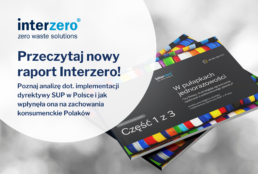
Although the provisions of the SUP Directive have been in force in Poland for over a year and a half, most Poles have not noticed any significant change in terms of packaging, plastic reduction or the availability of alternatives to single-use items – according to the latest data presented in the first part of the report “In the traps of disposableness”, entitled “The Curse of Disposable Plastic”, prepared by Interzero.
The revolution has come and gone, and few people have noticed it – this is how, in a few terse words, one might summarise the effects of the entry into force of the so-called Single-Use Plastics Act (hereinafter also referred to as the “SUP Act” – from Single-Use Plastic). Only 13% of respondents declared that they knew what the SUP directive was , what are its assumptions and goals, and what tools will be used to implement them. However, it is not about the awareness of Poles, but about the low effectiveness of the mechanisms implemented in Poland, which were supposed to help prevent waste and reuse products. One of them is the additional fee imposed on plastic packaging, effective from 1 January 2024, which was supposed to encourage us to use reusable packaging for drinks and food, similarly to plastic bags, which we have been paying for several years. The problem is that
that 42 percent of respondents never even noticed these additional fees . In contrast, as much as 56% systematically ignore them because they are usually so low in relation to the amount shown on the receipt (on average a few dozen groszy, with the highest being around PLN 2 per item), they do not encourage people to give up the convenience that the vast majority of respondents see in disposable packaging. “You don’t have to wash them, return them to any collection point or restaurant, or carry them with you in case of spontaneous decisions to order a takeaway meal” – respondents also pointed out during in-depth focus group studies conducted independently by Opinia24.
Reusable - still few incentives
Unfortunately, from the perspective of respondents, offering an alternative type of packaging in catering establishments is also a fiction. It turns out that this obligation is implemented more in theory than in practice - the vast majority of respondents (79%) have never encountered the possibility of choosing a different, more ecological packaging in a restaurant or when ordering takeaway. Only one in four consumers has ever come across information about a legally guaranteed (specifically under the SUP Directive) alternative in the form of reusable packaging. This was confirmed directly by the respondents themselves – “Only the choice of cutlery, whether you want extra plastic. That’s the only choice I have in the app. When I come to collect my takeaway, nobody asks me either. Or whether to give me a bag or let me carry it in my hand” – said one of the participants in the qualitative research. – “Usually there isn’t such an option; it’s simply the one option available in a given place. For example, a “Chinese” restaurant has its own containers, a pizzeria has pizza boxes, and no one asks if we want anything else. I didn’t have a choice,” the second respondent added. “[…] ”I’ll be honest, since 1 July, I’ve ordered many times – over 15 times or more – and no one, either in the restaurant or on the phone, has offered me anything like that,” another respondent pointed out.
What do the packaging we throw away say about us?
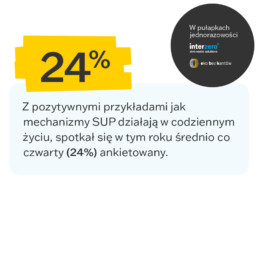
In the first part of the report “In the traps of reusability”, entitled “The curse of single-use plastic”, we will also learn a great deal about the eating habits of Poles: what they order most often, where and how they place orders (by telephone, via apps, in person), what they look for when examining the packaging offered to them, and what they think about reusable packaging. And these are just some of the conclusions drawn from the qualitative and quantitative studies designed to help diagnose and describe the state of implementation of the Single-Use Plastics Directive in Poland. The qualitative studies involved interviews with 24 people, whilst the quantitative CAWI studies were carried out on a nationally representative sample of 1,000 people. You can read the full publication here: https://ekobezkantow.pl/raporty/w-pulapkach-jednorazowosci/
About Eco without edges
In “Eko bez kantów”, we talk about ecology without distorting the truth. We tackle myths, fake news and half-truths. Our aim is to explain why waste should be sorted, not just how to do it properly. “Eko bez kantów” was created out of the belief that, in a world full of disinformation and greenwashing, there is a need for a reliable source of accurate information. We cover topics such as sustainable development, recycling, the circular economy and legislation relating to waste management. We discuss the impact of packaging, batteries and electronic waste on the environment, as well as ways to reuse them as valuable resources.
