
Recycling works. And it makes a tangible difference.
.
.The „resources SAVED by recycling” study enables an assessment of the impact of the circular economy, showing how many resources are conserved and how much greenhouse gas emissions are avoided through recycling. The study’s findings are subject to scientific evaluation by the Fraunhofer UMSICHT Institute

In collaboration with the Fraunhofer UMSICHT Institute, Interzero is developing an annual survey entitled „resources SAVED through recycling”. This scientifically sound life-cycle assessment enables an estimate of the contribution of recycling to climate and resource protection. It shows the quantities of primary resources saved through the recycling of materials and the volume of greenhouse gas emissions avoided. The study highlights the importance of the circular economy and illustrates its role in ensuring a sustainable future for the economy and society.
The results for 2025 demonstrate the potential circular economy: thanks to recycling, around 2 million tonnes of recyclable materials Interzero has saved over 7.2 million tonnes of primary raw materials in Germany, Austria, Poland, Italy and Slovenia. At the same time, the company’s recycling activities prevented emissions of over 900,000 tonnes of greenhouse gases.


* DB, Integrated Interim Report for 2025 | ** German Environment Agency, Environmental Costs Handbook – Methodological Convention 4.0
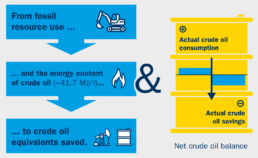
How can we present complex environmental impacts in an accessible way? In the study "resources SAVED through recycling" Specific calculation examples were used to make this impact easier to understand. In 2025, Interzero saved approximately 3 million barrels of crude oil, keeping around one million tonnes of plastic in circulation through recycling. This is roughly equivalent to 9.5 million refuelling stops for passenger cars 50 litres each.
But how were these calculations carried out? The calculations are based on a scientific impact indicator „Depletion of abiotic resources – fossil fuels”, which measures the consumption of fossil fuels, such as crude oil, natural gas and coal, throughout a product’s life cycle. To determine the savings, Fraunhofer UMSICHT It compares the energy required to produce plastics from virgin raw materials with the energy needed to recycle plastics. The energy savings thus achieved are then converted into an easily understandable unit using the energy content of crude oil. This makes the benefits of the circular economy transparent, measurable and tangible.
Shaping a sustainable future through recycling
Leaflet for the study "resources SAVED by recycling" 2025
We look forward to hearing from you. Get in touch with us.