
Waste management in the tobacco industry: production waste, post-consumer waste and excise goods
From managing over 30 waste streams from production to a proprietary process that recovers 95% of raw materials from used e-cigarettes. Discover Interzero’s ready-to-use services for the tobacco industry – collaboration models developed during real-world implementations and ready for use by other manufacturers.
Waste management challenges in the tobacco industry
the need to manage different categories of waste (packaging, packaging for hazardous substances, waste electrical and electronic equipment, accumulators and batteries, chemicals, production scrap, including electronic components)
growing public expectations regarding sustainable development
management of all waste streams covered by EPR legislation in the EU: packaging, electrical and electronic equipment, and batteries
fulfilment of obligations arising from the SUP regulations
fulfilling EPR obligations in a number of markets
strict supervision of the destruction of defective excise goods
organising the collection of used e-cigarettes and other novel tobacco products
efforts to increase recycling and material recovery rates
Proven waste management pathways for the tobacco industry
For the most voluminous and demanding waste streams from the tobacco industry, we have developed ready-made, tried-and-tested and cost-effective development strategies. They have been developed on the basis of data and experience gathered by our experts during previous implementations, and utilising the latest recycling and recovery technologies. Each solution is based on a tried-and-tested operational framework that we can roll out at the next manufacturing facility without having to design the entire process from scratch. This enables our clients to implement effective waste management processes within a short timeframe and realise the anticipated financial and environmental benefits.
A ready-made model means faster implementation, lower operational risk and predictable results, as demonstrated by previous projects. For international manufacturers, an additional benefit is the ability to use the same tried-and-tested solution in other countries, whilst adapting it to local legal requirements and market conditions.
Our waste management solutions can be implemented as standalone services or as part of a wider environmental management package for a site, retail outlets or the entire company. Tobacco product manufacturers can also gradually expand their partnership with Interzero, starting with the launch of a single process or the management of a single waste stream, and over time building a suite of services best suited to their individual needs.
We integrate the ready-made service into the company’s existing waste management processes, tailoring its scope to the scale of its operations, the organisation of the site and local conditions. We are planning to make changes to minimise the risk of disruption to production, waste logistics and the operation of waste storage areas. By utilising a previously developed operational framework, the client does not need to design a new process from scratch, and the solutions implemented begin to deliver tangible, real benefits within a short space of time.
Each of our ready-made waste models is based on tried-and-tested technologies, well-developed logistics and the experience we have gained from real-world implementations carried out at automotive companies and plants. The effectiveness of these solutions is confirmed by concrete results: hundreds of tonnes of difficult-to-recycle waste sent for recycling, thousands of components verified during service campaigns, or a reduction in the costs of managing selected waste streams by as much as 70%.
E-cigarette recycling – 95%: raw material recovery thanks to innovations from Interzero
Waste from novel tobacco products is a relatively new and challenging waste stream to manage – collecting small quantities of used devices from scattered collection points is costly, and the recycling of waste comprising multiple materials (plastics, metals, electronics, and built-in batteries or rechargeable batteries) is difficult and possible only in specialised facilities. Despite these limitations we recognised the high raw material potential of this fraction and we have designed a multi-stage process for processing, separating and recycling that is unique in the country, which enables a 95 per cent recycling rate for used e-cigarettes and refills. The recovered raw materials can then be returned to the supply chain and sold to manufacturers in other sectors.
We offer our proprietary process for the management of used e-cigarettes and cartridges to manufacturers and other companies in the tobacco industry as a turnkey service. We have a tried-and-tested and highly effective operational model which, following minor adjustments to suit the specific characteristics of each facility, ensures high recycling efficiency, delivers consistent results for our clients and relieves them of the obligations associated with managing post-consumer e-waste. In our turnkey e-cigarette recycling service, the client’s role is limited to arranging for the collection of waste and handing it over to our staff – all other activities: from the transport of used devices, through their recycling, to the provision of detailed confirmation of e-waste recycling, are carried out or coordinated by Interzero.
At the customer’s request, we can also supply containers for small electronic waste, sized to suit the conditions at the points of sale, and organise a comprehensive collection scheme for used e-cigarettes and cartridges from retail outlets.
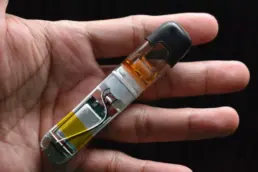
Used e-cigarettes as a source of recyclable materials – an Interzero customer success story
The initial problem:
A tobacco manufacturer organised the collection of used e-cigarettes and cartridges at each of its retail outlets. It was keen to ensure that the collected e-waste was recycled efficiently, guaranteeing the highest possible level of raw material recovery. The manufacturer expected the waste management service provider to provide full documentation of the process, including detailed recycling certificates specifying the percentage of materials recovered.
Our solution:
We implemented a reverse micro-logistics system within the client’s sales network – used e-cigarettes and refills were collected on the instructions of a member of staff using small vehicles, which helped to reduce transport costs. We then transferred the devices to a specialised facility, where they were shredded and separated into individual material fractions.
Result:
Precise separation and processing using advanced technologies have enabled the client to achieve a 95 per cent recycling rate for used e-cigarettes and cartridges, as confirmed by certificates provided by the recycler. The implementation of the Interzero Waste Platform has enabled the client to monitor the entire process, whilst also simplifying waste record-keeping and reporting.
The benefits of implementing Interzero’s e-cigarette recycling service
- 95% – recycling of raw materials
By utilising an advanced process for the separation and recycling of used e-cigarettes and cartridges - Operation of collection points across the country
Reverse micro-logistics ensuring the efficient collection of small batches of electronic waste from a decentralised network of collection points - Support for environmental objectives
A high recycling rate enables the raw material potential of end-of-life equipment to be utilised to the full - Process and cost optimisation
Collections carried out using small vehicles help to reduce waste logistics costs - Simpler BDO record-keeping
The Waste Platform streamlines the generation of documentation and the keeping of records relating to the transfer of electronic waste - Documented recycling rate
Detailed certificates confirming the recycling rate and the percentage of recovered materials
A single recipient for all waste generated from the manufacture of tobacco products
We offer a comprehensive waste management service for production facilities, based on a ready-made, tried-and-tested operational model for the tobacco industry. We collect waste directly from cigarette production (tobacco dust and residue, filters), packaging waste and defective batches of new products and we send them for lawful processing using sustainable methods. We also take full responsibility for the organisation and coordination of waste logistics, relieving staff at the facilities of time-consuming tasks. We also assign each client a dedicated account manager at Interzero, who is responsible for liaising with recyclers, planning and supervising waste collections, organising the destruction of products under customs supervision, and supporting staff in resolving day-to-day issues.
For each faction We select waste management methods in accordance with the waste management hierarchy, giving priority to solutions that enable materials to be returned to the cycle. Tobacco waste can be sent, amongst other things, for composting or anaerobic digestion in biogas plants. We use energy recovery in situations where a particular type of waste cannot be managed through higher-priority processes, for example, when destroying certain excise goods that are unfit for sale.
Simpler and less time-consuming waste management – an Interzero client’s success story
The initial problem:
A tobacco manufacturer organised a tender to select a company to provide a comprehensive service for the collection and management of waste arising directly from cigarette production. The service was to cover over 30 types of waste from the production plant, including tobacco dust, cigarette filters and unsaleable products. The manufacturer required the waste to be managed in accordance with the statutory waste hierarchy (recycling before energy recovery and landfill) and processed in a sustainable manner that complies with regulations.
Our solution:
We took part in the tender, offering the manufacturer a comprehensive service and carefully selected methods for managing the various waste streams from cigarette production. We proposed that tobacco waste and dust be sent to a biogas plant or a composting facility (depending on the cost-effectiveness of the method in question). We planned to send defective batches of cigarettes in their packaging to an on-site incinerator, which generates energy and raw materials for cement production.
Result:
We won a tender to manage over 30 waste streams from cigarette production. The client entrusted the collection and management of all key waste streams to a single company (Interzero), thereby reducing the number and time-consuming nature of waste management processes and freeing up the company’s internal resources.
The benefits of entrusting Interzero with waste management for the tobacco industry

- One recipient for multiple batches
Over 30 types of production waste managed as part of a single partnership - Compliance with the company’s environmental policy
Priority is given to sustainable waste management methods that comply with customer requirements and the statutory waste management hierarchy - Support for the Circular Economy
Priority should be given to recycling and processes that allow materials to be returned to the cycle - Process and cost optimisation
Collections carried out using small vehicles help to reduce waste logistics costs - Compliance Guarantee
At every stage: from collection, through transport and processing, to final disposal and the preparation of waste documentation - A single point of contact
A dedicated contact at Interzero who coordinates collections, liaises with recyclers and supports the client’s waste management staff with their day-to-day tasks - Optimisation of waste management
Limiting the number of processes handled by the manufacturer’s staff helps to ease the workload on staff and free up the company’s internal resources
Destruction of tobacco products under customs supervision
A specific type of waste from the tobacco industry comprises products withdrawn from the market, defective production batches and damaged goods, which must be destroyed under customs supervision and in accordance with the customs regulations of the relevant country. As part of our services for companies in the tobacco industry, we organise the entire process – from submitting an application for a destruction permit, through the collection and disposal of the products in accordance with the conditions set out in the administrative decision (where applicable), right through to drawing up the destruction report and providing it to the client along with full waste documentation.
Efficient organisation of the collection of excise goods from customers frees up warehouse space and enables it to be reused for current production, whilst ensuring its immediate destruction and proper documentation enables the swift settlement of public levies. Every one supplied by us the destruction report meets the requirements laid down for accounting documents. This enables companies in the tobacco industry to correctly record financial losses resulting from the destruction of products in their accounting records and to demonstrate that such products have been disposed of during customs, tax or environmental inspections.
Other environmental services for the tobacco industry
management of various fractions of post-production waste (including packaging)
developing individual management pathways for used tobacco products
fulfilment of WEEE obligations in relation to waste equipment and batteries in all EU markets
the organisation of a collection scheme for used e-cigarettes and other novel tobacco products in retail chains and outlets
ongoing environmental consultancy
environmental audit of a production plant
fulfilment of SUP obligations for companies in the tobacco industry
a digital platform designed to facilitate waste management, including arranging waste collections and reporting waste data
fulfilment of EPR obligations in relation to packaging in 31 European markets (the EU-27, the UK, Norway, Serbia and Switzerland)
consultancy on PPWR, including packaging audits
FAQ
Please write to us at platformaodpadowa@interzero.pl and briefly outline your requirements. Our expert will review your enquiry and contact you to discuss the possibilities for working together.
Yes. We handle various types of post-production and post-consumer waste (e.g. from collection points at retail outlets), including electronic components, batteries and rechargeable batteries, complete and dismantled devices, e-cigarette cartridges, and packaging for essential oils and e-liquids.
The cost of our services is always calculated on a case-by-case basis and depends on the scope of the service. Every company and every production facility generates different types and quantities of waste and has different expectations regarding additional services. Please contact us and let us know your requirements, and our expert will prepare the best offer for you, taking into account the specific nature of your business.
Inspections cannot be completely eliminated, particularly in a highly regulated sector. However, the risk of penalties, non-compliance and adverse inspection outcomes can be significantly reduced through proper documentation, up-to-date reporting, compliance with environmental obligations and ongoing monitoring of legislative changes.
Companies in the tobacco industry are often wary of changing their existing operating procedures due to risks relating to operations, audits, a loss of continuity in waste collection and recycling, and potential errors in documentation. However, a properly planned implementation and support from an experienced team make it possible to mitigate all these risks, maintain process continuity and avoid downtime in production and waste logistics. Interzero’s experts understand the specific nature of operations at tobacco manufacturing plants, which is why they are able to anticipate potential difficulties and prevent them in advance. They also have experience in implementing integrated and turnkey solutions for companies in the tobacco industry, as well as operational know-how that enables them to plan subsequent steps effectively and guide each facility safely and smoothly through the implementation process.
In the course of external audits and inspections carried out by state institutions The party to the proceedings is always a trader – this is required by law and cannot be altered by agreement with any other party. However, Interzero supports clients undergoing an audit or inspection by, amongst other things,:
- preparation of documentation,
- carrying out analyses,
- the creation of reports,
- preparing explanations for the auditor or the supervisory body.
We do not leave our clients to fend for themselves – we remain in constant contact with companies requiring support, advice or clarification on the process and potential consequences of an audit. As a result, our clients are better able to cope with the heavy workload associated with inspections and can efficiently provide inspectors and auditors with the required information and documents.
EPR obligations for companies in the tobacco sector may cover several different waste streams simultaneously – including packaging, electrical and electronic equipment, and batteries. Legislative requirements and the manner in which these obligations are fulfilled vary from market to market, which is why international companies often turn to local environmental consultants who, amongst other things, organise collection and recovery systems, provide support with waste record-keeping and fulfil reporting obligations. At Interzero, we take on the fulfilment of EPR obligations across all EU markets. Tobacco companies therefore do not need to establish partnerships with multiple overseas entities – instead, they can choose a single trusted partner who will ensure compliance with EPR regulations and, in addition, provide support in fulfilling SUP obligations.
Compliance with ESG objectives also requires monitoring of how waste is actually managed and the collection of reliable data on the results achieved (e.g. recycling and recovery rates, the weight of waste sent to landfill, etc.). Interzero combines the fulfilment of EPR obligations with the organisation of sustainable waste management processes. Furthermore, it provides clients with detailed reports and certificates confirming the effectiveness of recycling and recovery processes, enabling companies to simultaneously meet legal requirements and document the environmental impact of their operations.
We ensure that the process of disposing of or recycling products is organised in accordance with legal requirements, safety procedures and environmental requirements. The process can be properly documented and monitored to ensure it meets audit and compliance requirements.
We also work with other sectors

Contact

platformaodpadowa@interzero.pl