

Packaging recycling performance classes in the PPWR – what do categories A, B and C mean?
For many years, packaging manufacturers were able to assess for themselves whether the packaging they designed was recyclable. In practice, this meant that similar designs could be assessed in different ways, and the term „recyclable packaging” itself did not always mean the same thing. The PPWR Regulation puts an end to this discretion – it establishes a uniform assessment and classification system that will enable the recycling performance of packaging and its compliance with eco-design criteria to be reliably determined. The result of this assessment will determine which of the three recycling efficiency classes the packaging is assigned to.
Assessing the recyclability of packaging in accordance with the PPWR – key principles
Regulation The PPWR stipulates that, from 12 August 2026, all packaging placed on the EU market must be recyclable. From 1 January 2030, however, the recyclability of each item of packaging must be expressed in performance classes A, B or C. For manufacturers, this means they must review their entire packaging portfolio in advance and redesign it in accordance with design-for-recycling criteria (Design for Recycling, DfR).
The manufacturer is responsible for assessing the recyclability of the packaging and assigning it to one of the performance classes. However, the PPWR does not specify how this assessment is to be carried out – detailed guidelines will be set out in delegated acts, which the European Commission is to adopt by 1 January 2028. The manufacturer is required to include confirmation of a given packaging’s compliance with the recyclability requirement and with the criteria for the relevant recycling performance class in the EU declaration of conformity.
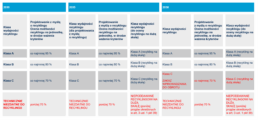
Class A – the highest packaging recycling performance class in the PPWR
Class A is the highest category of packaging recycling performance as provided for in the PPWR Regulation. This includes packaging designed in accordance with the principles Design for Recycling, which can be sorted and processed with minimal material loss.
Classifying packaging as Class A means that:
- The packaging achieves the highest level of recyclability and meets the most stringent design-for-recycling criteria (Design for Recycling, DfR),
- the recycling efficiency rating is at least 95%.
Class A will be the most sought-after, not only in terms of compliance with the PPWR, but also in view of the future modulation of EPR fees, which is intended to reward packaging that is best designed for recycling
Class B – high recycling efficiency with minor restrictions
It is designed for packaging that they are highly suitable for recycling, but do not meet Class A requirements. Classifying a package as Class B means that:
- the packaging recycling rate is at least 80%, but does not exceed 95%,
- Most of the material can be recovered and reused as a high-quality recyclable material,
- The packaging may contain elements or features that make recycling slightly more difficult.
Class C – permitted only until 2038.
Class C is the lowest recycling efficiency class as provided for in the PPWR Regulation. This means that between 70% and just under 80% of the packaging’s weight is suitable for material recycling. Class C therefore includes packaging that meets the minimum criteria of the PPWR Regulation regarding design for recycling, but whose construction or material composition hinders the effective recovery of some materials.
What about packaging that does not meet Class C requirements? Packaging that receives a rating lower than 70% is deemed technically unsuitable for recycling and (with a few exceptions) may not be placed on the market after 1 January 2030.
Manufacturers of packaging classified in category C will only be able to place it on the market for a limited period – starting from From 1 January 2038, Class C packaging will be subject to a marketing ban. This means that only packaging classified as Class A or B will remain on the market – that is, packaging with a recycling performance rating of at least 80%. Businesses that manufacture and use Class C packaging should therefore treat it as a temporary solution and, in parallel, work on its eco-design.
Additional packaging classification from 2035 – large-scale recycling assessment
From 2035, a new factor – an assessment of large-scale recycling – will be added to the criteria analysed when assessing the recyclability of packaging.
What does „large-scale recycling” mean? For a given category of packaging to be considered as being recycled on a large scale, waste from that type of packaging must be separately collected, sorted and recycled within established systems and through recycling processes that have been proven in practice. At the same time, the recycling rate for this packaging at EU level must be:
- 30% for wooden packaging,
- 55% for other materials.
Packaging will therefore undergo a two-part assessment: an assessment of recycling performance (compliance with eco-design criteria) and a large-scale recycling assessment, which will also be expressed in grades from A to C. The thresholds for determining compliance with the requirements of the large-scale recycling assessment and for assigning packaging to specific categories will be laid down in delegated acts of the European Commission. This is intended to ensure that packaging placed on the market is actually recycled once it becomes waste. Packaging that does not meet the requirements of Class C will be deemed not to be recyclable on a large scale and will therefore not be allowed on the market.
This means that, from 2035, the assessment of a packaging item’s recyclability will be based on two factors. Firstly, it will be checked whether the packaging has been designed in accordance with the principles of ‘Design for Recycling’. Secondly, an assessment will be made of, Is this particular category of packaging actually recycled on a large scale?. The detailed rules for this assessment, including the methodology and thresholds for individual packaging categories, will be laid down in delegated acts of the European Commission.
Which packaging is not subject to classification A, B and C? Exceptions to the recyclability requirement
Certain types and formats of packaging are exempt from the recyclability requirement. In accordance with Article 6(11) of the PPWR Regulation, these are:
- packaging direct (i.e. containers and other types of bulk packaging that come into contact with medicinal products or veterinary medicinal products),
- packaging intended to come into contact with sensitive products, used for packaging medical devices (including in vitro diagnostic devices),
- outer packaging (i.e. that in which the immediate packaging is contained), provided that it is necessary to ensure compliance with specific quality preservation requirements medicinal product,
- packaging for use with sensitive products; for the packaging of preparations intended for the initial and subsequent feeding of infants, and processed cereal products and on baby food (e.g. packaging for infant formula, baby cereals, ready meals, desserts and soups),
- packaging for foods for special medical purposes,
- packaging transport regulations for dangerous goods,
- commercial packaging produced made of light wood, cork, textiles, rubber, ceramics, porcelain or wax (which are exempt from the recyclability requirement but are still subject to EPR fee modulation).
You can find out more about PPWR on our LinkedIn profile:
Contact

biuro@interzero.pl
