
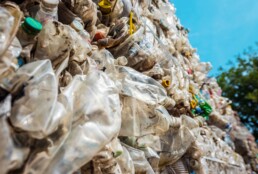
Plastic recycling in Poland – we still incinerate it more often than we recycle it
Although the levels of separate collection of plastic waste are rising year on year, Poland is still failing to realise the potential of the raw material it collects. A report published in May 2026 by Plastics Europe shows that most plastic waste does not end up being recycled, but is sent to incinerators. The low circularity rate for plastics is not merely an environmental issue – at a time when Europe is increasingly committed to the circular economy and is mandating the use of recycled materials, this situation could lead to serious problems with the availability of recycled raw materials and a decline in the competitiveness of Polish companies.
We’re harvesting more and more, but we’re still not processing enough
The latest report from Plastics Europe The Circular Economy for Plastics – A European Analysis 2026 provides further worrying information that highlights the problems facing the Polish and EU plastic recycling sectors. According to the data presented in the report, 2.089 million tonnes of post-consumer plastic waste were collected in Poland in 2024. Only 436,000 tonnes, or 21% of the total stream, were sent for recycling. This means that only around one-fifth of the plastic was returned to the material cycle. The remainder of the waste was managed using other, less sustainable methods – as much as 865,000 tonnes, or 41.4%, of plastic waste was sent to incinerators, whilst 788,000 tonnes (37.7%) was disposed of in landfill. However, from a circular economy perspective, incineration should be a last resort, used only when recycling is not economically viable or impossible due to a lack of suitable technology.
Low levels of plastic recycling have a negative impact on manufacturers of raw materials and plastic products. The limited supply of recycled plastic, combined with price competition between virgin and recycled plastic, means that Only the 30% plastic production process currently relies on recycled materials – both post-consumer (19.6%) and pre-consumer (10%). The remaining 70% of plastics are still produced from virgin raw materials derived from fossil fuels.
Poland is no exception. Europe is also grappling with this problem
Excessive landfilling and insufficient recycling are not merely local problems – similar trends are observed across Europe. A report by Plastics Europe shows that of the 32.7 million tonnes of plastic waste collected in the EU27+3 countries, only 29.6% was recycled. At the same time, as much as 48.9% of waste was sent to incineration plants, and a further 21.5% to landfill sites. This means that over 70% of plastic waste is still not being returned to the material cycle.
Of all plastic waste Packaging waste comes closest to being circular – In Poland, 30% of plastic packaging is recycled, whilst the average for the EU+3 is 40.5%. Plastic waste from agriculture and horticulture ranks second (20% in Poland and 32.5% in the EU27+3). Between 2022 and 2024, both of these waste streams recorded an increase in their recycling rates. The opposite trend is evident in the category of plastic waste from the automotive sector – currently, 9% of this waste is recycled in Poland (compared with an EU average of 17.7%), and between 2022 and 2024, the EU recycling rate for this waste stream fell by as much as one-third.
Data from the automotive sector is particularly interesting in view of the approaching Vehicle ROP – The new regulations are set to require manufacturers to use at least 20% of recycled material in the production of new vehicles.
The authors of the report point out that, despite the increase in collection and sorting rates, Europe still lacks sufficient recycling capacity, and some of the sorted waste is exported outside the region for further processing. To prevent the loss of raw materials caused by exports and to protect third countries from excessive environmental burdens, the EU has amended the rules on cross-border shipments of waste, introducing, amongst other measures, a ban on the export of plastic waste.
Find out about the new regulations on the cross-border shipment of waste >>
Separate waste collection is still important
The Plastics Europe publication focuses not only on systemic issues, but also highlights the importance of individual efforts and actions. One such effort is the separate collection of plastic waste, which enables a significant amount of raw material to be returned to the cycle. The current recycling rate for separately collected plastic stands at 46.5%, whereas for waste entering the mixed waste stream, this figure is only 2.3%.
Countries that invest in technologies for sorting residual waste stand out significantly above the EU average. Thanks to improved sorting processes in Germany, Poland and Spain, it has become possible to recover a greater quantity of plastics from mixed waste, and the recycling rate for plastics from this stream has risen from 3.8% to 5.6%. However, separate collection remains the main source of waste sent for material recycling. Experience in these countries shows that even the most advanced sorting technologies are unable to completely replace source-separated collection. Mixed waste is significantly more contaminated, which limits its potential for reuse and increases the likelihood of it being sent for thermal treatment at a waste-to-energy plant.
Sources:
- A dramatic slowdown in Europe’s transition to a circular plastics system, https://plasticseurope.org/media/circular-economy-report-2026-dramatic-slowdown-in-plastics-circularity/
- Plastics Europe, The Circular Economy for Plastics: A European Analysis, https://plasticseurope.org/wp-content/uploads/2026/05/Circular-Economy-Report-2026-full-report.pdf
- Poland is drowning in plastic. Only 21 per cent is recycled, https://www.bankier.pl/wiadomosc/Polska-tonie-w-plastiku-Tylko-21-proc-trafia-do-recyklingu-9135839.html
- Plastics Europe, The Circular Economy for Plastics: A European Analysis – Executive Summary, https://plasticseurope.org/wp-content/uploads/2026/05/CER26-SINGLEPAGE-Executive-Summary.pdf
Contact

biuro@interzero.pl