
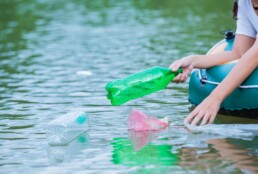
Fewer returnable bottles, more glass. What does the rubbish in rivers tell us about the waste management system?
On 30 April 2026, the annual „Clean Odra” campaign came to an end, during which volunteers collected litter from the riverbanks and the water for the fifth time. One stage of the campaign involved not only a major clean-up, but also an analysis of the composition of the waste, which served as a test of the effectiveness of Poland’s waste management policy and the new measures implemented over the past 12 months.
Waste composition from the 5th edition of the ‘Clean Odra’ campaign
Thanks to the commitment of the Waste Free Oceans (WFO) Foundation, Dominik Dobrowolski, the West Pomeranian Province Landscape Parks Team and the Regional Water Management Authority in Szczecin (Wody Polskie), On 22 April 2026, an analysis was carried out of the composition of the waste collected during the clean-up campaign in Międzyodrze in the Lower Oder Landscape Park. This was the first study of its kind covering the period following the introduction of a deposit scheme for PET bottles and cans in Poland. It therefore had the potential to provide answers to questions regarding the rationale behind the implementation and the effectiveness of the Polish deposit scheme model.
During this one-day event, the following was collected:
- 240 kg of glass,
- 77 kg of plastic,
- 6 kg of aluminium cans not subject to a deposit,
- bulky waste (including tyres, garden furniture and other items).
We discuss the Odra clean-up campaign and other nature conservation initiatives in more detail on the ‘Eko bez kantów’ podcast: A clean Oder, a clean Vistula – is that possible? An interview with Dominik Dobrowolski
The deposit scheme is working – just two returnable bottles in Międzyodrze
As expected, the analysis of the composition of the waste collected during the clean-up of Międzyodrze has yielded some interesting findings regarding the recently launched deposit-refund scheme. During the all-day clean-up operation the volunteers found just two returnable bottles. Importantly, the result from Międzyodrze was no fluke – the organisers of the „Clean Oder” campaign noted that This year’s campaign collected far fewer plastic bottles and cans than in previous years. Although these figures do not yet conclusively prove the effectiveness of the deposit scheme, they clearly show a trend that is likely to continue in the coming months – packaging with economic value rarely ends up in the environment.
For environmental experts, this is a sign that a well-designed scheme based on a financial incentive to return packaging can reduce the amount of litter in the countryside.
Is single-use glass the new plastic?
The introduction of a deposit-return scheme and a significant reduction in the amount of discarded plastic packaging have led to a noticeable change in the composition of the waste collected during clean-up operations along the River Oder. In previous editions of the campaign, PET bottles and aluminium cans made up the bulk of the contents of the volunteers’ bags, but in 2026 these were replaced by single-use glass bottles. A morphological analysis showed that as much as 60% of the total mass of collected recyclable waste consisted of glass. Next on the list was waste that has been lying in the environment for years and is not regularly removed by local authorities. This mainly refers to old PET bottles and aluminium cans, which volunteers mostly found in hard-to-reach places.
The event organisers emphasise that glass waste is not merely an aesthetic problem – although it does not break down in the environment and does not emit harmful substances, it can pose a fire risk, and, when broken, it poses a danger to people and animals.
The results of the analysis and a detailed report on the Odra clean-up campaign have contributed to the ongoing debate on the possibility of introducing a deposit scheme for single-use glass bottles, particularly the so-called „małpki”. Small alcohol bottles are one of the most common types of litter found in the natural environment and in urban areas. Including them in the deposit-return scheme could have a measurable environmental impact comparable to that currently seen with PET bottles – instead of ending up in the natural environment, the glass would go into a bottle return machine and then be recycled. The Ministry of Climate and Environment is currently working on such a solution. The outcome of this work and the final decision on the future of single-use glass bottles will likely be announced after the summer holidays.
Read also: New rules for returning glass bottles under the deposit scheme >>
Contact

biuro@interzero.pl