
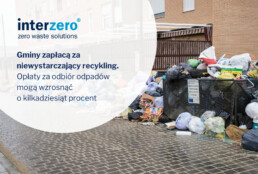
Municipalities will pay for insufficient recycling. Waste collection fees could rise by several tens of percent
Many municipalities will not achieve the EU-required levels of preparing for re-use and recycling of municipal waste in force between 2023 and 2025. Local authorities are already protecting themselves against the financial consequences of failing to meet their obligations, and industry representatives are saying straightforwardly: residents should prepare for increases in waste collection fees of up to 10-20 per cent.
Recycling rates in municipalities still too low
The spectre of severe consequences of insufficient waste management hangs over local authorities - the penalties they face are caused by failure to achieve the minimum statutory levels of municipal waste recycling. The problem does not only concern individual municipalities scattered across Poland - its scale is much larger. In 2024, in the Lubuskie Voivodeship alone, as many as 64 of the 82 municipalities failed to achieve the 45 per cent recycling rate.
In a survey conducted in February 2025 by the Association of Municipalities and Districts of Greater Poland, more than 80 per cent of the municipalities surveyed stated that they were unlikely to achieve the recycling minimum target for this year. Thanks to the efforts of the climate and environment ministry, The EC has exceptionally agreed to reduce the recycling rate planned for 2025 by 5 pp, to 50 per cent of the. For some municipalities, however, even the preferential 50 per cent threshold is a distant dream. Piotr Szewczyk, Chairman of the RIPOK Council, points out that the problem will only grow in the near future:
„This 45 per cent that we have to achieve for 2024 is still achievable in our technical conditions and with this kind of separate waste collection. The problem will be in the following years.”
Meanwhile minimum requirements are increasing year on year - in accordance with Article 3b(1) of the Act on Maintaining Cleanliness and Order in Municipalities:
- In 2023, municipalities were required to recycle 35 per cent of the mass of municipal waste.
- From 2024, the minimum recycling rate increased to 45 per cent.
- The next leap was 2025, when municipalities had to recycle 55 per cent of the weight of municipal waste collected.
Of course, the problem with municipal waste recycling does not affect all municipalities. Some municipalities have far exceeded the legal minimum, achieving 60-70 per cent recycling annually. In 2024, the national record recycling rate was as high as 88 per cent.
The problem has been growing for years - the EU and the NIK have been sounding the alarm for a long time
The real risk of not meeting EU requirements has not been known for a while - already in 2018. The EC had sounded the alarm that Poland might not achieve the 50 per cent preparation for re-use and recycling rate required under the then legislation. At the time, the EC's fears were confirmed, and hundreds of municipalities across Poland have received heavy financial penalties. A few years later, the problems with municipal waste management were reported by the NIK - in a report published in mid-2025. Information on the results of inspections of GOZ implementation indicated:
According to NIK, there is a high risk that Poland will not achieve the level of preparation for reuse and recycling of municipal waste required by the EU, i.e. a minimum of: 55 per cent by 2025 (or a lower level as a result of the postponement of the target at Poland's request), as well as a significant risk of failing to achieve the level of their landfilling (maximum 30 per cent by weight in 2025-2029, up to 20 per cent in 2030-2034, up to 10 per cent from 2035). This may result in appropriate penalties being imposed on municipalities (by way of a decision by the provincial environmental inspector), as well as on Poland by the Court of Justice of the European Union.
Even though the required recycling levels will increase at a much slower rate from 2026 onwards (by 1 pp per year, up to 65 per cent in 2035 and beyond), it is still likely that some municipalities will not be able to achieve them.
Penalties for municipalities included in waste collection fees
Problems in municipal waste management are also recognised by waste companies, which, like municipalities, want to prepare for the penalties they face. And the fines will not be small - in 2025. For each tonne of waste below the statutory minimum recycling and PDPU, municipalities will pay more than £433. As Piotr Szewczyk points out, entrepreneurs operating municipal waste systems already include the costs of possible penalties in their contracts with municipalities:
„This share is currently between 10 and 20 per cent, and these are the increases we face in the near future if we don't do anything about it.”
These will not be the first increases, the CSO reported, budget expenditure on municipal waste management increased by up to 70 per cent between 2019 and 2024, from PLN 560 to PLN 970 per tonne. The highest jump in charges was recorded in the Lower Silesian Voivodship (by PLN 494) and the lowest in the Świętokrzyskie Voivodship (by less than PLN 230).
In the absence of a ROP, all additional costs are likely to be passed on to residents in the form of further increases in waste collection fees.
Read also: The controversial ROP bill - aims, objectives and criticisms
The bail system and storage levels will also drive up collection costs
The worries of local authorities do not end with municipal waste recycling - the same Article 3b of the Act on Maintaining Cleanliness and Order in Municipalities in point 2a obliges them to reduce municipal waste landfill.
Municipalities are obliged not to exceed a storage level of:
- 30 per cent by weight - for each year between 2025 and 2029;
- 20 per cent by weight - for each year between 2030 and 2034;
- 10 per cent by weight - in 2035 and beyond.
Meanwhile, the CSO reports that in 2024. nationwide, exactly 30% of municipal waste generated is landfilled[i]. In the current market situation, reducing landfill levels by a further 20 pp in just 10 years seems unlikely. According to Piotr Szewczyk, penalties imposed on municipalities for failing to meet statutory levels could result in a 3-5 per cent increase in the value of contracts with waste companies.
Another factor that will negatively affect the municipal waste budget will be the take-off of the deposit system, which will „deprive” municipalities of access to valuable yellow-bag raw materials - aluminium and PET bottles.
„In the event that the entire stream is taken over by the bail system, ultimately after a transitional period, we have estimated the loss of revenue from not receiving these raw materials at our facilities, as well as from not selling these raw materials and not gaining revenue from DPRs, to be approximately PLN 570 million, which translates into an approximately PLN 1.4 increase in waste management costs per capita,” explained the RIPOK Council chairman.
Read also: Will rubbish charges go up?
https://www.nik.gov.pl/plik/id,30907,vp,33980.pdf
[i] CSO, Environmental protection 2025, https://stat.gov.pl/obszary-tematyczne/srodowisko-energia/srodowisko/ochrona-srodowiska-2025,1,26.html