Entrepreneur, remember to submit your annual CO2 emissions report for 2023
Entrepreneur, remember to submit your annual CO2 emissions report for 2023
We would like to remind you that until 31 March 2024. the operator of the installation or aircraft operator is required to submit to the National Balancing and Emission Management Centre (NABM) the verified annual report for 2023, i.e. the annual emission report together with the verification report. By the same date, the operator or aircraft operator shall submit a copy of the report and a copy of the report to the authority competent to issue the permit.
The documents should be prepared on Excel-formatted forms based on the forms and guidelines promulgated by the European Commission, available on the website of the National Centre at www.kobize.pl under "Downloads".
More information HERE
For our customers using the environment whose activities cause emissions, Interzero prepares and enters into the National Base, by the end of February each year, a report containing the information indicated in Article 6(2)(1) to (10) of the Act of 17 July 2009 on the system for managing emissions of greenhouse gases and other substances, concerning the previous calendar year.
Need more information on air emissions and your responsibilities? Take advantage of the training on Interzero Academy.
- TRAINING | The most common errors in emissions and waste reporting
- TRAINING | Obligations of businesses regarding air emissions
More training here: https://academy.interzero.pl/
If you are unsure whether your company is meeting its environmental obligations correctly, use the Environmental Audit conducted by our experts!
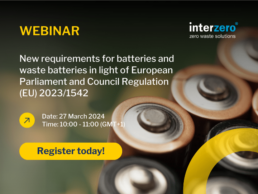
Take part in the international Interzero webinar "New requirements for batteries and waste batteries in light of Regulation (EU) 2023/1542 of the European Parliament and of the Council"!
Take part in the international Interzero webinar "New requirements for batteries and waste batteries in light of Regulation (EU) 2023/1542 of the European Parliament and of the Council"!
You are hereby invited to a webinar entitled. "New requirements for batteries and waste batteries in light of Regulation (EU) 2023/1542 of the European Parliament and of the Council", which will take place on 27 March 2024 (Wednesday).
The online training will be conducted by: Przemyslaw Kuna, Managing Director of Interzero Polska
Scope of the webinar:
- sustainability and safety requirements
- labelling and marking requirements
- the role of introducers, importers and distributors
- implementation of due diligence systems
- management of battery waste, including extended producer responsibility
More details and the registration page can be found HERE
Registration for the webinar is open until: 27 March 2024 at 8:00 am.
Register today!
Join the event on LinkedIn HERE
Amendments to the law on the bail system in Poland
Amendments to the law on the bail system in Poland
On 7 March, a press conference was held at which Anita Sowinska, Deputy Minister for Climate and Environment, spoke about the proposed changes to the bail system.
What will change?
- VAT-free deposit. Both single-use and reusable packaging will be exempt from VAT.
- The bail will 'follow' the packaging. As in other countries with a bail system.
- Deposit amount - 50 gr for plastic packaging and for metal cans and £1 for glass bottles.
- Obligation for small shops that sell such beverages to accept reusable glass packaging.
- Inclusion of dairy packaging from 2026.
- Inclusion of standard reusable glass packaging.
- Harmonised labelling system for returnable packaging - common returnable packaging symbol and barcode.
View a transcript of the conference HERE
As Interzero, we are ready for the upcoming statutory changes. You can already familiarise yourself with our offer Bottle machinesthat will make it easier for you to collect returnable packaging in your retail network.
We also offer expert advice to companies setting up and participating in a deposit system: to manufacturers and distributors and to representative entities. We provide a comprehensive service for deposit systems with regard to, among other things, the collection and logistics of packaging and packaging waste and its management. You can join a system set up by us and PIOIRO in order to be guaranteed to meet your statutory obligations. More information HERE
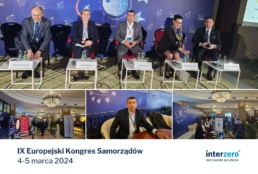
Summary of the 9th European Congress of Local Governments Economic Forum
Summary of the 9th European Congress of Local Governments Economic Forum
On 4-5 March 2024, Mikolajki hosted the IX European Congress of Local Governments. The event, on behalf of Interzero, was attended by Pawel Lesiak, Vice President of the Management Board. The theme of this year's edition was 'The future of the idea of decentralisation in a changing world'.
Technological development, social change and challenges
Local government reforms have brought decades of successful economic growth and regional development to Europe. The self-government reform in the Third Republic is considered one of the best, enabling the effective absorption of EU funds, participation in cross-border programmes and the implementation of strategic regional projects.
However, severe turbulence, both in Poland and across Europe, has had a negative impact on the decentralisation of power in recent years. The pandemic caused a sudden break in supply chains, which undermined the idea of borderless globalisation, leading to consolidation and centralisation of power. This edition focused on building a vision of an effective, modern and proactive local government. There were also topics related to environmental protection and recycling.
The deposit system as a positive example of recycling
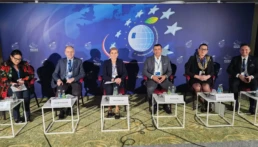
In the panel discussion "Returning plastic bottles on deposit - positive examples of recycling". attended:
- Paweł Lesiak - Vice-President of the Management Board, Interzero Organizacja Odzysku Opakowań S.A.
- Katarzyna Michniewska - President of the Management Board, Eko Cykl Organizacja Odzysku Opakowań S.A.
- Konrad Nowakowski - President, Polish Chamber of Packaging Recycling and Recovery
- Anita Palukiewicz - Partner, SSW Pragmatic Solutions
- Jakub Sprusiński - Director of Product Development and Sales, T-MASTER S.A..
The discussion was moderated by Agnieszka Sznyk, CEO, INNOWO.
In 2025, the obligation to collect plastic bottles will be 77% and the target is 90% from 2029. This is a requirement under the provisions of the SUP Directive. Achieving such high levels will only be possible by deposit system - Currently, around 45% of plastic bottles are collected. In 2025 we will therefore be short of 32%. The bailing systems in 2025 will only be taking off, so getting to full efficiency will be staggered.
Are the planned collection levels realistic to achieve?
However, this does not mean that the 2025 level is at risk. The deposit will significantly affect the propensity to return packaging. An example of this is aluminium cans, which are currently collected at levels in excess of 70% despite the lack of a deposit and a universal collection system. However, the value of the raw material (around £5 per 1kg) encourages collection and transfer to collection points. Approximately 55 cans come in at 1kg, meaning that handing over a can to a collection point yields about 2 gr per can. With a deposit rate of at least 50 gr, collection levels will certainly not be lower than at present. Similarly high levels will also be achievable for plastic bottles.
The collection of bottles in a deposit system will allow this waste to be separated from other waste to ensure the quality required for the production of recyclate for food contact packaging. In 2025, the required level of recyclate in plastic bottles will be 25% and in 2030. 30%.
The PPWR stipulates that the proportion of recyclate in bottles will increase to 65% by 2040. The PPWR assumes that from 2030 there will be a required level of recyclate in all plastic packaging. In 2025, EU regulations require a 50% and in 2030 a 55% recycling level for plastic packaging waste. PPWR assumes that the European Commission may propose more ambitious recycling targets, including for plastics.
Necessary statutory changes
The removal of plastic bottles from the municipal waste stream will reduce the revenue of municipalities from the sale of this waste collected from residents. It is therefore necessary to quickly introduce ROP provisions adapted to the new requirements of the Waste Directive, which will increase business participation in financing the costs of waste collection in municipalities.
The amendments to the bail regulations signalled by the Ministry may not introduce revolutionary changes that would shatter the assumptions adopted in the Act for its operation. Nevertheless, several changes are necessary to improve its functioning in the future, e.g. the creation of an umbrella organisation that will, among other things, centrally account for the bail collected and returned.
It is also necessary to allow cans and bottles that are waste to be transported from shops by vehicles that deliver products to shops (amendments to the Waste Act). This will reduce the amount of packaging collected from shops, which will reduce the carbon footprint.
Also important is the demand to use the commercial infrastructure to store or sort collected packaging without having to obtain a waste collection permit granted through a lengthy administrative procedure.
You can read more about Interzero's role in the Polish bail system by reading HERE
Check out our range of recyclers HERE
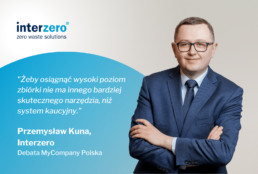
Responsible as a producer or in anticipation of a revolution - MyCompany Poland debate
Responsible as a producer or in anticipation of a revolution - MyCompany Poland debate
Why is Extended Producer Responsibility an important topic for bail scheme participants? What role will municipalities play in the system? What will the PPWR directive change? These and other questions were answered by participants in the MyCompany Poland debate, in which Interzero was represented by Przemysław Kuna, Managing Director at Interzero.
Last week, the debate 'Responsible as a Producer, or Awaiting a Revolution' took place, featuring Przemysław Kuna, Managing Director at Interzero, Krzysztof Baczynski, President of the Board of the Association of Employers of the Packaging and Products in Packaging Industry EKO-PAK and Artur Lobocki, Board Member of the RECAL Aluminium Packaging Recovery Foundation.
Participants in the debate leaned into issues related to the enactment of a deposit system in Poland from 2025, as well as the new packaging collection levels dictated by the transposition of the PPWR Directive. It was noted that the new deposit fees pose a high risk to the market in view of the low level of secondary material recovery in Poland. Attention was also drawn to the low awareness of waste recycling among Poles. The experts stressed the important role of municipalities in the system and about the legitimacy of penalties and product fees.
We encourage you to read the entire material HERE.
Interzero Poland and the Polish Chamber of Packaging Recovery and Recycling will create a representative entity for companies in the deposit system - find out more here: https://systemkaucyjny.pioiro.pl/.
Environmental education and public education campaigns - Interzero report 2023
Environmental education and public education campaigns - Interzero report 2023
As Interzero Organizacja Odzysku Opakowań S.A. and Interzero Organizacja Odzysku Sprzętu Elektrycznego i Elektronicznego S.A., we carry out educational campaigns for entrepreneurs who have transferred their packaging recovery obligation to us as part of their statutory obligation. We invite you to read the report on our educational activities in 2023.
In 2023, we have been active in the area of implementing educational projects and campaigns aimed at both children and young people and adults, including businesses and consumers.
- As part of the project Eco-friendly without the frills, we educate Poles about ecology, environmental protection and waste segregation. We have realised 7 episodes of the podcast (also available in Apple Podcasts, YouTube i Spotify), and we were able to gather a wide reach on our social media profiles on Facebook i Instagram.
- EcoPakThe educational materials for schools, including lesson plans, colouring books, games and art materials related to raw materials, were distributed to the 120 nursery schools that were most active in the local authority campaign. Cycling in May.
- We have also developed our own educational game 'Action-fraction!which teaches young and old about correct waste segregation in an accessible way. The game was available at events supported by Interzero.
- As part of our collaboration with the Mamy Projekt collective, we became the content patron for one of the rooms of the newly opened education centre Turning point at 88 Jagiellońska Street in Warsaw, where children and young people learn the secrets of fast fashion and learn about packaging. We also support the travelling exhibition EcoExperimentarium, which was visited live by more than 13,000 visitors last year alone; and 499,000 online players.
- Together with the Museum of Photography in Krakow we realised The project "Closed Circuit. Waste in Photography", based on journalism and photography workshops, while with UNEP/GRID-Warsaw - the a series of workshops in the Royal Baths Park and an exhibition of 10 collages encouraging waste reduction. The exhibition can be hired via the Cooperative.
- We also organised many activities during the next edition of Zero Waste Fair, and we also provided content support for three themed days in the Kindergarten Calendar programme, run by the It's Simple Foundation and Intersnack in the 'Don't Throw Away, Use' programme.
- Once again, together with UNEP/GRID-Warszawa and the Czepczyński Family Foundation, we have become a partner in the educational program implemented by the Maspex Group. Winnie the Pooh friends of nature, which has been in operation for 16 years and has reached 10 million children.
As part of its business education activities, Interzero prepared 8 online training courses on reporting, changes dictated by the transposition of the SUP Directive or waste management, and other training courses available on the Interzero Academy platform. We also held the 10th Anniversary Edition of the Interzero Environmental Conference, for the first time in an open format, where we focused mainly on the topics of SUP and the establishment of a deposit system. Our experts appeared in debates and other publications from titles such as Forbes, MyCompany and Rzeczpospolita, as well as in trade magazines (Now Environment).
We encourage you to read the details of the report HERE.
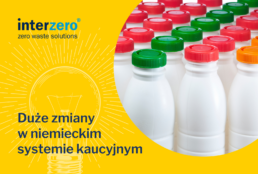
Big changes in the German deposit system!
Big changes in the German deposit system!
From January 1, 2024, the German Pfandsystem also covers selected bottles of milk and similar drinks.
The German deposit system (Pfandsystem) has been in operation for almost 20 years and covers plastic bottles, aluminium cans and glass bottles. From January 1, 2024, it covers another group of packaging - from now on, German stores will charge a deposit of €0.25 for bottles of milk and similar drinks with a capacity above 0.1 L.
The new deposit includes, among others:
- Milk bottles;
- Milk-based beverage bottles;
- Bottles of cocoa and coffee drinks with milk content above 50%;
- Bottles of drinking yoghurt and kefir.
New regulations have been introduced by the largest German supermarkets. In its current form, the deposit system in Germany covers almost all non-returnable drinks in bottles and cans.
The Polish deposit system for returnable packaging will start in 2025. The deposit obligation will apply to single-use plastic bottles for beverages with a capacity of up to 3 L, reusable glass bottles for beverages with a capacity of up to 1.5 L and metal packaging for beverages with a capacity of up to 1 L. Interzero, together with the Polish Chamber of Packaging Recovery and Recycling, will create a deposit system - read more HERE .
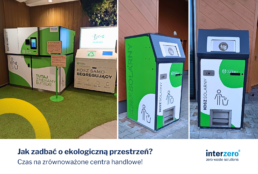
Eco-friendly retail space in Janki Shopping Centre
Eco-friendly retail space in Janki Shopping Centre
Taking care of green urban spaces is important for a number of reasons. Firstly, such places attract huge numbers of people every day, which means that even small changes can have a big impact on the environment. Implementing modern solutions in a shopping centre, for example, can improve the level of waste segregation, increase the environmental awareness of visitors to the place, or save and reduce the costs of operating the building and its surroundings.
Education of the public plays a key role in promoting green practices. Shopping centres are an excellent place to communicate environmental awareness and the benefits of a green lifestyle. Through information campaigns, educational events or practical examples, people can be effectively made aware and visitors can be encouraged to make more informed consumer decisions.
ESG, or Environmental, Social, and Governance, is not just about declarations on social and environmental responsibility, but finally concrete and measurable actions. Increased pro-environmental measures can be seen in various sectors of the economy, including larger retailers such as Janki Shopping Centre.
The facility incorporates a range of solutions and investments that ultimately contribute to reducing the carbon footprint, saving resources and educating the public.
The commercial space has been designed in the spirit of #zerowaste - various eco-equipment can be used in the building, such as bicycle-loaders or solutions provided by Interzero - bottle machine, self-segregating bin i solar basket. The centre authorities also took care of the green areas around the building - insect houses and composters were used to preserve the biosystem.
As Interzero, we very much welcome initiatives that have a positive impact on the planet. We hope that other facilities of this kind in our country will also work on ecological retail space.
You can read more about the sustainable solutions used in Janki Shopping Centre in the article at the link: HERE
Check which eco-equipment can be useful in your commercial space!
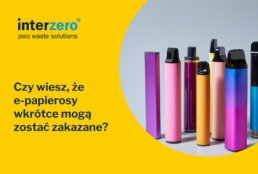
Did you know that e-cigarettes may soon be banned?
Did you know that e-cigarettes may soon be banned?
According to a study conducted by the Institute of Economic Planning and Analysis (IPAG) on the sale of e-cigarettes, over 100 million disposable e-cigarettes were sold in Poland in 2023. At the same time, according to an article published in The Lancet, e-cigarettes pose an increasing challenge to our environment. The first problem is the generation of a significant amount of plastic, especially in the case of cartridges that are intended for single use and are made of hard-to-degrade plastics.
The second problem is electronic waste. Research conducted by the Material Focus organisation has shown that in the UK alone, 1.3 million such devices end up in landfill every week, even though they should be sent to e-waste collection points. Improper disposal of batteries and other components may lead to fires and environmental pollution.
Nicotine is also a problem, not only because it is addictive, but also because it is considered hazardous waste in some countries. Therefore, plastic containers in which liquids and e-cigarette cartridges are stored cannot be recycled.
At the end of January, the British government announced its plan to ban the sale of disposable electronic cigarettes, which will have a positive effect not only on the environment, but also on the health of the entire society. Last week, the Polish Deputy Minister of Health also announced that the possibility of a complete ban on the sale of e-cigarettes is being considered.
Source: https://www.pap.pl/aktualnosci/e-cigarettey-najlepsze-szkodliwym-dla-srodowiska-produktem-jaki-cześni-powstal , https://next.gazeta.pl/next/7,151003, 30672748,there will be a total ban on the sale of e-cigarettes-resort-health.html .
Amendment to the regulations implementing the deposit system in Poland and changes in waste management
Amendment to the regulations implementing the deposit system in Poland and changes in waste management
On February 14, a press conference was held during which the Deputy Minister of Climate and Environment, Anita Sowińska, talked more about waste management solutions, changes in the BDO system, as well as about the planned implementation from 2025. deposit system.
During the event, the Deputy Minister emphasised that the deposit system, as assumed, would be launched at the beginning of 2025, but we can expect amendments regarding the system operators. The representative of the ministry emphasised that these changes would only be "technical". This will concern obligations and documents submitted to control the system.
On March 5, there will be a consultation meeting with the industry, local government officials and trade representatives regarding changes to the Deposit Act. The deputy minister added that the deposit system, although it will start on January 1, 2025, "may happen that it will not be perfect from the very beginning, because the act requires some adjustments."
The deputy minister also informed about planned changes in the BDO system . The modernisation will respond to the main needs of users of this system. The changes will include, among others: development of the Report Module and introduction of new functionalities in the Account Management Module.
The press conference participants were also presented with the expanded composition of the of the Advisory Team on waste management solutions. The advisory staff will include: Lewiatan Confederation, UNEP/GRID-Warsaw, INNOWO Institute for Innovation and Responsible Development, Polish Chamber of Waste Management, Polish Recycling Association and the National Fund for Environmental Protection and Water Management, as well as more representatives of the entrepreneurs' side, mainly from the recycling industry, as well as non-governmental organisations and institutes.
Source:
https://zielona.interia.pl/smieci-plastik/news-system-kaucyjny-nie-ruszyl-a-juz-ma-byc-poprawka-wiceministr,nId,7335652#google_vignette
https://www.gov.pl/web/klimat/wiceministra-anita-sowinska-o-rozwiazaniach-w-zakresie-gospodarki-odpadami
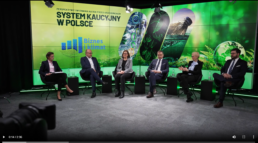
Video: Dziennik Gazeta Prawna
As Interzero, we are happy to participate in debates and meetings with the ministry and industry representatives to better clarify our mutual needs and discuss current legal changes. We encourage you to read the summary of the debate "Deposit in a year, and the system in its infancy". on Dziennik Gazeta Prawna HERE , where Pawel Sosnowski, Management Board Representative for Environmental Regulations with Interzero had the opportunity to discuss issues related to the deposit system together with: Andrzej Gantner, Vice-President and General Director at the Polish Federation of Food Producers Association of Employers, Anita Sowińska, Undersecretary of State at the Ministry of Climate and Environment, Joanna Kasowska, Director of Quality and Food Management Standards , Żabka Group; Filip Piotrowski, Climate Leadership, UNEP/GRID-Warszawa; Anna Larsson, Director of Implementation of circular economy models, Reloop Platform.